In the first blog I talked about what is social media analytics, in this blog, I’m going to talk about applying social media analytics in helping reduce world hunger.
Social media
Social media is always a useful way to promote the world hunger, people know about companions in hunger in different regions, without access hunger, they can contribute to the reduction of hunger and rase money for hunger people. Using social media to help realize zero hunger, we always focus on its ability to disseminate information, for example, to start up an activity and funding for hunger on social media, with propaganda, to achieve the purpose of widely spread.
Social media analytics
Different from social media, the purpose of social media analytics is not to disseminate information, but to collect and analyze data. The information collected from social media can be divided into content that people post on related topic content and information that is not specifically targeted but can be used indirectly.
Directly analysis
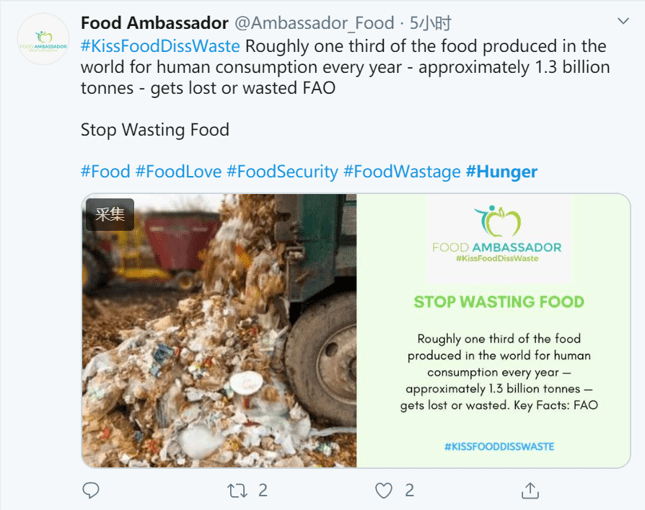
When activist publishes content on related topics on social media, and guides users to comment, like or vote, and the user’s views on the topic content can be digitization. In figure1, twitter can be sent with hashtag, those directly related data can be scraped and text analytics can be introduced for data analysis (e.g., people’s point of view and suggestions).
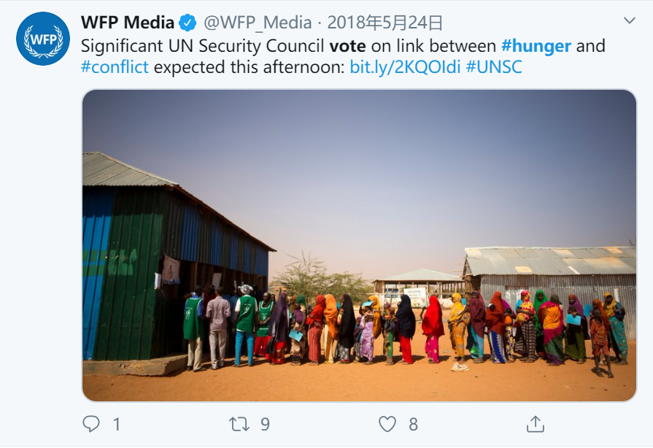
In figure2, there is a link involves a vote website, the voting data can also be used for certain purpose.
Indirectly analysis
Users do not directly follow the news or topics related to hunger, but the content shared by their social networking sites can obtain information related to the reduction of hunger. For example, many users post their daily lives on social media networks, including food-related parts. In different regions and different seasons, users’ sharing content will be different. Such information is collected, and through picture or text analysis, demographic-based food characteristics can be obtained. With the feature of foods in different seasons and regions, relevant departments can know about the trends of foods change and the preference of people, with the analysis of phenomena and behaviors, make some adjustments to food production.
 IEMS5720-Social Networking-Xiong Wy
Your present the function of Social Media and Social Media Analytics respectively. In SMA part, you say: “the purpose of social media analytics” is “to collect and analyze data”. But actually collecting and analyzing is not a purpose, but a tool, or way. The final goal is to solve hunger. So it’s a logic problem.
Next, in the “Indirectly analysis” part, you say these indirect information can help “make some adjustments to food production”. But these indirect information is posted on the Internet just becuase users don’t lack food. For those who in hunger, they don’t show their daily life because they even have no enough food, let alone sharing life on social media.
LikeLike
Thanks for your advice, you have noticed me about the logical problem in this blog, it’s useful and I should pay more attention to the logic and coherence of description when organizing articles.
LikeLike
You explained in two points how social media analytics can solve the world’s widespread hunger problem. One is the direct analysis and the other is indirect analysis. But I think the article may need to be more specific. What I found interesting was the “Hunger Map Live” launched by Alibaba and the World Food Program.(https://www.alibabagroup.com/cn/news/article?news=p190926)
Maybe analyze social media such as Twitter, Facebook, and then attach the analysis results to this map, which can help this map be more timely Map monitoring capabilities are more powerful.
LikeLike
Thanks for your advice. Representing the analysis results on a map is a very intuitive method, which can graphically describe the situation in different regions, helping us have a clearer and more specific understanding.
LikeLike
The types of analysis are divided into direct analysis and indirect analysis. In the part of the direct analysis, the followers, the hashtags of topics, the content of posts, and the data comes from vote websites are comprised of your data, to analyze the people’s views and suggestions. In another part, the content is also used, but for the detection of hunger news or problems and also the people’s preference for food. From my perspective, the analysis based on similar data should put in the same part, namely, direct analysis. BTW, it is my understanding, maybe different from yours. Anyway, the job is still very meaningful, come on!
LikeLike
Dear Ming, thanks for your comment! I do agree that similar data should be put in the same part, in case we can better analyze and understand the result. Maybe text messages on social media networks should be put together when analyzing them.
LikeLike
The structure of your blog is very clear. It is divided into social media, analysis, direct and indirect parts, which are progressive and helpful for readers to understand. You mentioned that relevant departments can understand people’s concerns about food supply and make some adjustments to food production through the analysis of phenomena and behaviors on social platforms. I think this is a perfect understanding of SMA. Very great job!
LikeLike
Glad you like it. It difficult to introduce Sma in helping stop hunger, people can access the internet and have the opportunity to share their points of view are not really the target groups to reduce hunger. Therefore, the data obtained on social platforms will always be biased.
LikeLike
So glad to see that you put more focus on how SMA can be used to achieve the goal. Honestly, it’s really a hard part for me to consider before reading your article. I do like your structure which divides the analysis ways into direct and indirect.
I think we may not do many surveys related to hunger daily, so more analysis is indirect. one idea is that we can use SMA to analyze the food waste circumstances and then adjust the publicity methods. Normally food waste is proportional to the regional economy. So I believe it’s easier to do publicity in those areas!
LikeLike
Your suggestion is so good about food waste. Many foods are wasted in developed areas while in poor areas it will appear much less often. We can find out about hunger by investigating waste and take measures to help fund, and at the same time take measures to reduce waste in areas where food is wasted, these two aspects can help zero hunger.
LikeLike
Hahaha, we both chose the same topic. Compared with the measures I thought, your plan is more feasible and the analysis is more in-depth. After reading your blog, I have more ideas, thanks
LikeLike
Sorry for late review, I missed the notice. I have read your blog as well, and we both mentioned poverty. Poverty affects our lives in many ways, lack of food and education, which hinders the development of society and the happiness of people’s lives.
LikeLike